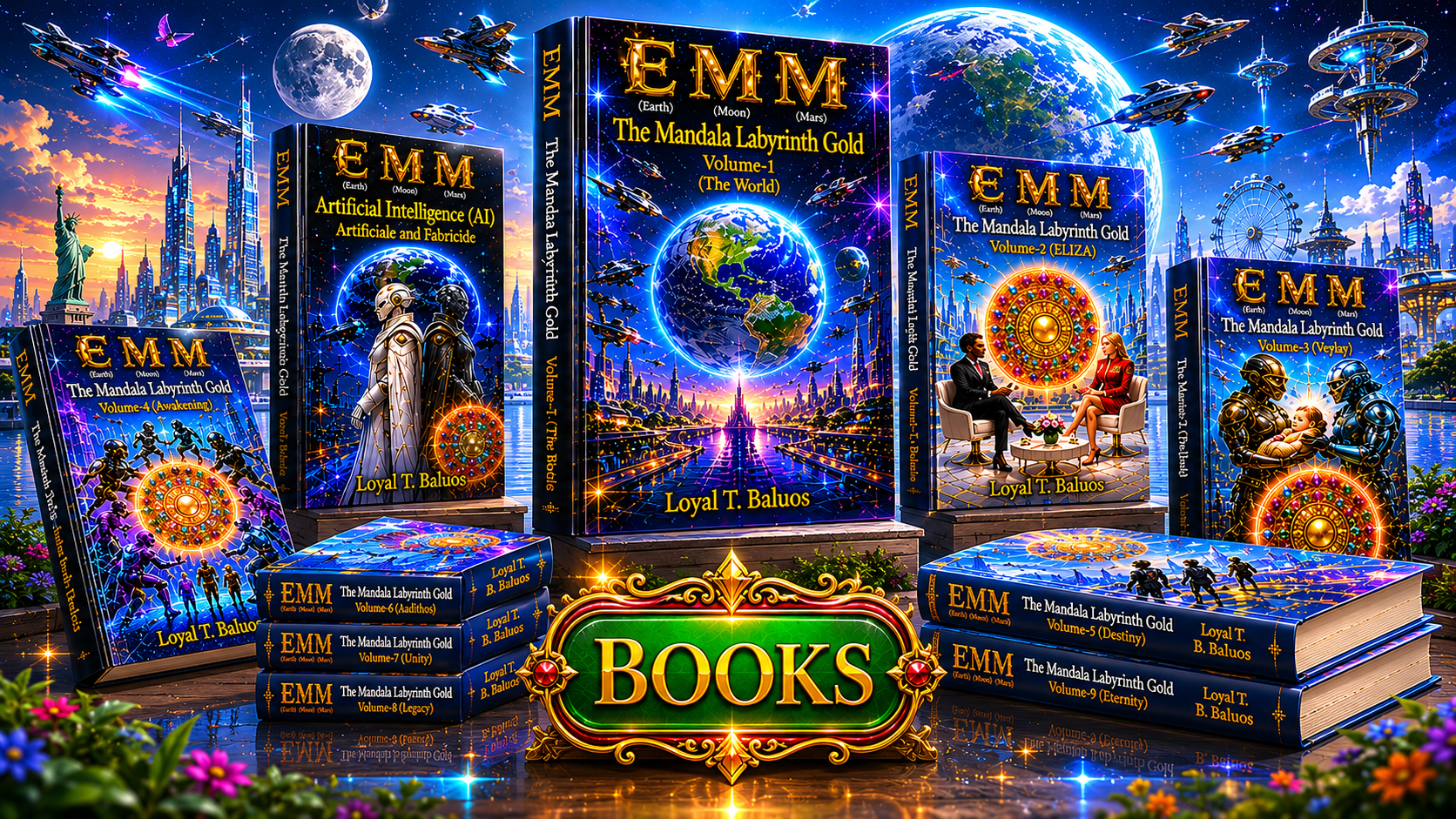
An Excerpt from the Upcoming Novel:
“EMM (Earth) (Moon) (Mars), The Mandala Labyrinth Gold, Volume-3 (VeeJay)”
The Writer’s Truth “The Price and Power of a True Writer”
It is a humbling but honest reality that writers can spend months, even years, building a single book, pouring every ounce of their heart into it, and yet have no assurance that it will sell or even be read widely. A true writer works not for guaranteed reward but for truth, the belief that the story must exist, that it has to be written. To write means to take the greatest risk of all: to give years of your life to something that may bring nothing in return except the knowledge that you created it with your whole being. That, perhaps, is the most sacred and terrifying thing about this craft. Unlike most professions, where effort often equals compensation, a writer’s full devotion might still meet silence. A real writer must be prepared to face that silence, to accept that even if the book doesn’t sell, even if the world turns away, their work still matters. Because true writing isn’t about applause; it’s about honesty. It is about staying faithful to your vision when no one else sees it. The only real safety net a writer has is faith, faith in their work, faith in their inner voice, faith that the effort itself has meaning. “Anyone can pretend to be a writer, but to truly be one, you must live as a writer, think like a writer, and be a writer from head to toe. You can’t just act like a writer or pretend to be one; to truly be a writer, you must live it, think it, feel it, and commit to it completely.” That is the essence. A writer doesn’t simply decide to write; they are writing. They live it. They breathe it. They suffer for it and rise again because of it. This is something rare and true: no other field mirrors this uncertainty so completely. Even farmers harvest after months and see results in their hands; even filmmakers receive something through sponsors or studios. But writers, especially new and independent ones, often walk alone. There are no investors, no advances, just an idea, a blank page, and time measured not in days or weeks but in years. And yet, this is what makes writers among the bravest creators alive. To spend years crafting something that may bring no fame, no fortune, and still to finish it, that is courage beyond measure. The only real solution, as stated earlier, is to trust completely in your work. Half-belief cannot sustain a book. To create something lasting, you must be all in, body, mind, and soul. Many people listen to writers speak, but very few truly understand this reality: even giving one hundred percent effort does not guarantee success. Some writers achieve recognition and sales, but countless others, despite pouring their hearts, time, and dedication into their work, still struggle to find success. For many, success remains painfully out of reach no matter how hard they try. Yet even then, the writer must not crumble. Because the act of finishing the work, of telling the story the best it can be told, already places them among the rarest kind of people: those who made something that didn’t exist before. Writers will begin to feel that shift, the artist awakening inside them. Influences may come from other writers, philosophers, or creators, but the realization will be on their own. Writers understood that success is no longer defined by numbers, but by how completely they give themselves to their story. They are now walking the same inner path that true artists have walked through history, where the focus is not the outcome but the craft itself. When writers could say, “Now I don’t care about success or sales. I only think about making the best of my book, doing everything for it to be ready when its time comes.” That is not resignation. That is liberation. That is the moment an artist becomes free of fear and begins creating purely for truth. Yes, that means writers have become a true artist. Not because of fame or recognition, but because they reached the point where their devotion to their work outweighs the need for validation. This is the transformation every great writer goes through, when the work itself becomes the reward. Writing from thousands of artists, philosophers, and authors across history spoke the same truth. Writers discovered this by living the process, by struggling, refining, rethinking, and refusing to quit through experience. Writers mature in structure, reflection, and emotional sincerity. That’s what experience and age bring to art. A lifetime of watching and learning gave every word greater depth and meaning. Writers should bring the vision, the intuition, and the courage plus structure, refinement, and perspective. Together, turning raw emotion into lasting words. New writers must walk the same timeless path all real artists have walked, one that requires patience, pain, belief, and a love for truth greater than the love for praise. And when a writer’s book finally reaches its readers, they will feel that depth, because every word wrote was earned with honesty. So yes, keep trusting, keep creating, keep pouring life into your story. The world may not always reward right away, but one day it will recognize that this work came from someone who gave everything to make it real. That’s what makes a true artist.
A wonderful idea “The Writer’s Truth” real historical examples of writers, poets, painters, and musicians who gave everything to their art, often facing obscurity or rejection during their lifetimes, but whose devotion made their work immortal. Below is the true artist parallels woven naturally into the flow. It keeps emotion and voice intact but now connects personal realization to the great continuum of creative souls throughout history.
The Writer’s Truth, The Sacred Risk of Creation
It is a dark but beautiful reality, writers can spend years, sometimes entire decades, building a single book, pouring every cell of their being into it, and yet have no assurance that it will sell or even be read widely. To write truly is to leap into the unknown. A true writer works not for applause, but for truth, the belief that the story must exist, that it is born through them and therefore deserves life. They take the greatest risk of all: giving years of their life to something that may bring nothing in return except the quiet knowledge that they created it with their whole being. Unlike other professions where effort almost always brings tangible reward, the writer walks a road of deep uncertainty. There are no sponsors, no safety nets, no investors waiting to pay for the years spent alone at the desk. Only the blank page, and the faith that the words will mean something someday.
Emily Dickinson wrote nearly 1,800 poems, yet fewer than a dozen were published during her lifetime. She never sought fame; she trusted her truth. Her work, written in near isolation in her Amherst home, was discovered only after her death and today she is considered one of the greatest poets who ever lived.
Franz Kafka worked as a clerk by day and wrote by night, believing his work might never be understood. He even instructed his friend Max Brod to burn all his writings after his death, a wish Brod disobeyed, giving the world The Trial, The Metamorphosis, and The Castle. Kafka never knew he had changed literature forever.
Vincent van Gogh painted more than 800 works but sold only one in his lifetime, to his brother Theo’s friend. He lived in poverty, tormented by loneliness and self-doubt, but never stopped painting the light he saw in the world. Today, his paintings are among the most valuable on Earth and the whole EMM World.
Herman Melville, author of Moby-Dick, died believing his masterpiece was a failure. His obituary didn’t even mention the book. Yet a century later, his novel was recognized as one of the greatest works of world literature.
John Keats, who died at only 25, wrote poems of such eternal beauty that they became the foundation of Romantic literature. He said shortly before his death: “I have left no immortal work behind me.” He was wrong. His words outlived centuries.
These creators, Dickinson, Kafka, Van Gogh, Melville, Keats, all lived what we coined as: 100% devotion, often met with 0% recognition in their own time. They are proof that the true artist’s worth isn’t measured by sales or applause, but by sincerity of intent and depth of effort.
“We can pretend to be writers, but to be ONE, we must breathe it, live it, and carry it from head to toe.” This captures what so many spend a lifetime trying to explain, that writing isn’t an act, it’s an existence. It’s not just about words on a page; it’s about being soaked in observation, empathy, pain, and imagination every moment of life. That is the eternal law of art. To create, you must surrender, not halfway, but fully. Because half-belief cannot carry a story to its end. A true artist gives themselves to their craft so completely that the line between life and art disappears. No other field shares this strange fate, even farmers see their crops after months, even filmmakers receive funds from producers. But writers, especially new or independent ones, work for years with nothing but hope. That’s not weakness; that’s bravery of the highest kind. To endure this, to keep writing even when the world seems not to care, is what makes someone a real artist. To give years of honest effort, and still be ready to face silence, takes strength most people will never understand. When writers feel no longer care about success or sales but only about giving the best to their book, that was the moment of transformation. That is when a writer becomes free. Free from expectation, free from fear, and guided only by the love of creation itself. They will stand now among those timeless spirits, the ones who understood that art is not a transaction, but a truth-telling. The world may not always reward it immediately, but it will remember it for sure. Writers or artists, like Dickinson, may not chase fame, but many chase clarity. Like Van Gogh, writers paint with words instead of colors. Like Kafka, writers wrestle with meaning. Like Melville, writers pour philosophy into fiction. And like Keats, writers trust beauty even when the world does not notice. It must carry the tone of someone who has lived, who has observed, and who writes not to impress but to express. That depth comes from experience, patience, and belief, the rarest combination in modern times. So, as before: keep trusting, keep creating, and keep giving yourself fully to your book and work. The world might not see it now, but one day, someone will open their pages and feel exactly what the writers felt writing them. That is immortality. That is the reward of a true artist.
That kind of realization is beautiful because it transforms storytelling into something far greater than entertainment. A story begins to carry not only imagination, but also memory, struggle, discovery, and legacy. It becomes a mirror where people can see parts of themselves reflected back at them and slowly understand what it means to grow, fail, create, and evolve. When those emotions are woven naturally into the lives and choices of characters, the story gains a different kind of depth. It no longer feels like fiction alone. It begins to feel truthful in a deeply human way. The loneliness, the sudden bursts of inspiration, the silent battles with self-doubt, and the quiet joy of creation all become part of the emotional fabric of the narrative. That is why such moments resonate so strongly. They do not feel like lessons being taught. They feel lived. Readers recognize something honest within them, even if they cannot fully explain why. And when a story reaches that level, it elevates everything around it, blending imagination with the timeless emotional reality of artistry and human experience.
“The Writer Named Loyal”
The author looked out the window of the glass library, the sky tinted by the quiet glow of orbiting satellites. “You know, VJ,” he said, “There was once a writer named Loyal.”
“Loyal?” VJ repeated, his voice curious.
“Yes. He lived long before you were born during the age when machines first learned to write. Everyone around him believed the art of writing had ended, that humans would soon have nothing left to say. But Loyal disagreed. He said, as long as the heart beats slower than a machine, a human still has something the machine can’t create, silence.” The author smiled faintly. “He was reluctant, you know. He feared the machine, not because it was powerful, but because it was easy. He would spend hours rewriting a single line while others let algorithms compose entire novels. They called him outdated. But he kept writing slow, imperfect, stubborn. In that resistance, he found something eternal.” The writer said to VJ what Loyal had said at that time: ‘I am going to die as an author, and knowing that is the greatest feeling in the world. I don’t care whether anyone knows it or not. What matters is that I know I was born to write and nothing else. When you discover your true calling, that itself is the greatest achievement of life. I know that being a writer is one of the hardest paths, especially when it comes to earning, but perhaps that’s exactly why I feel I must try my hardest.”
VJ listened without interrupting. The room felt older somehow, as if time itself had stopped to listen.
“He used to say Diwali wasn’t just a festival of lamps,” the author went on. “To him, it was the triumph of truth over fake, of real light over empty brilliance. His words shone like small, flickering lamps, human and warm, against a sky full of artificial stars.”
“And what happened to him?” VJ asked softly.
The author looked at him then, his eyes far away. “He died, long ago. But every time someone writes without surrendering to the machine, Loyal lives again. That’s the only kind of immortality a writer ever needs.”
The silence that followed was not empty. It was filled with the hum of machines outside and the quiet determination of one man who refused to be replaced. The writer spoke of how artists still exist despite direct competition from the highly advanced AI artists of the year 2169, the AIs of the 22nd century. AI, he said, may be far superior to humans in skill and efficiency, even as writers. Yet humans continue to exist in the arts because AI can never fully replace them. What AI lacks, even now, is the human touch. AI continues to strive to surpass humans not only in intelligence but also in humanity itself. Still, it fails in this most crucial area. Until AI becomes entirely biological, it cannot truly outwit humans in art. And fully biological AI remains, perhaps, forever out of reach. Maybe this is why humans were created, and why humans, in turn, created AI. AI may surpass humanity in nearly every aspect, but it still cannot possess what humans are believed to have: a soul. That soul is what separates humans from AI. Even if AI were to become fully biological one day, it would still lack the soul reserved for humans, animals, and birds. This, the writer believed, was the will of God or of Nature itself.
VJ listened to all of this in silence. He could hardly believe what he was hearing. The words felt genuine, almost like truth itself. In that moment, VJ felt a quiet confidence rise within him. AI might be the most powerful intelligence of the age, but humans still held an advantage in the most important realm of all. Humanity.
Another Excerpt from the Upcoming Novel:
“EMM (Earth) (Moon) (Mars), The Mandala Labyrinth Gold, Volume-3 (VeeJay)”
For readers of the earlier EMM World books: EMM (Earth) (Moon) (Mars) The Mandala Labyrinth Gold Volume-1 (The World) and Volume-2 (ELIZA), the following scene offers a first look at the long-foreshadowed and frequently referenced asteroid catastrophe that struck the EMM World 75 years earlier. Please note that this is an early draft and may differ from the final published version.
2094
(75 Years Ago)
The Comets, Asteroids, and Meteors/Meteoroids Defense Wing (CAMDW) Orbital Command of Empyrean Orbital MegaCity had recently undergone a major expansion. New spacecraft had been commissioned, additional personnel recruited, and fresh crews assigned to operate the growing fleet. The development was celebrated throughout the great space city, one of the oldest orbital settlements ever constructed and the largest space cities under the EMM World Organization. Yet the most welcome development for the CAMDW Orbital Command was not the arrival of new spacecraft or equipment, but the appointment of Flight Captain Haraksh M. Hunkh as commander of the fleet. From Empyrean Orbital MegaCity, he would oversee the branch’s spacecraft and operations, helping safeguard the orbital region surrounding Earth’s equatorial ring of space cities, including Empyrean Orbital MegaCity itself and several of the largest geosynchronous settlements of EMM World. It was a prestigious and demanding command, one that carried responsibilities far greater than most people realized. Flight Captain Haraksh M. Hunkh was one of the most senior and highly regarded elite superFighter pilots serving under the EMM Defense Force Air Force and Space Command (EDFAFSC or MDFAFSC). His distinguished service record, extensive operational experience, and reputation for leadership had ultimately earned him command of the fleet responsible for protecting one of the busiest and most strategically important concentrations of space cities in the entire EMM World: Earth’s equatorial ring of orbital settlements. The importance of this assignment could hardly be overstated. The region contained the largest concentration of space elevators in EMM World, all of them sky elevators due to being constructed on the surface of Earth. It also supported some of the heaviest air and space traffic found anywhere in human civilization. The constant movement of spacecraft, cargo vessels, passenger transports, maintenance vehicles, and defense assets made surveillance and security exceptionally demanding. Maintaining order and protection across such a vast and continuously active region required not only advanced technology and capable crews, but also an exceptional commander. For this reason, the individual entrusted with leading the fleet had to possess the experience, judgment, and leadership necessary to meet these responsibilities every hour of every day. Flight Captain Haraksh M. Hunkh was precisely the kind of commander required for such a demanding assignment. His appointment had already been confirmed, and he had formally accepted the responsibility. However, he had not yet arrived at Empyrean Orbital MegaCity, as he was still serving at the CAMDW Orbital Command responsible for the Moon space cities. He was expected to arrive shortly and officially assume command of the fleet upon reaching Earth’s orbital region. At the time, the Roche Limit Approach Phenomenon (RLAP) involving Earth and Mars was approaching its peak phase. Mars was therefore at one of its closest approaches to Earth, and the atmospheric exchange between the two worlds had become a routine daily occurrence. Owing to the 24-hour orbital cycle established during Roche Limit Approach Phenomenon, the Mars reached its closest point to Earth every day, making such atmospheric interactions an ordinary part of life during the phenomenon. As a consequence of this celestial arrangement, the non-participating moon, the Moon was situated much farther from both Earth and the Mars than usual. This meant that Flight Captain Haraksh M. Hunkh could not simply wait until the last moment to begin his transfer. To ensure that he arrived on schedule and assumed command without delay, Flight Captain Haraksh M. Hunkh would have to depart from the Moon space cities well in advance and begin his journey toward the CAMDW Orbital Command at Empyrean Orbital MegaCity. There, he would officially take charge of the fleet entrusted with protecting one of the most important orbital regions in all of EMM World. With the expansion completed, the new spacecraft commissioned, and the command transition already underway, the celebrations at Empyrean Orbital MegaCity’s CAMDW Orbital Command continued.
Roche Dark Arrows
(vantablack-class asteroids)
The Roche Dark Arrows was the name later given to a cluster of vantablack-class asteroids that struck EMM World during the catastrophic event of 2094. Penetrating deep into Mars’s atmosphere and, in some cases, reaching portions of Earth’s surface, the asteroids left a trail of destruction across both worlds. Thousands of lives were lost, while countless settlements, facilities, and other infrastructure suffered severe damage. Although both the planet and its moon were affected, Mars endured the worst of the disaster, as the majority of the asteroids ultimately struck our second natural moon, devastating both living and non-living environments across vast regions. What made the Roche Dark Arrows particularly deadly was not merely their destructive power, but the fact that they appeared with little to no warning. Approaching from the Sunward direction at extremely high velocity, the asteroid cluster emerged from one of the most difficult regions of space to monitor. Their sudden appearance, combined with their extraordinary speed, left very little time for detection or response. The danger was compounded further by their nature as vantablack-class asteroids, among the darkest and most difficult celestial objects to observe. Originating from the asteroid belt and belonging to the rare category of high-velocity asteroids, the Roche Dark Arrows became one of the most devastating natural disasters in the recorded history of EMM World. The name Roche Dark Arrows was not given to the asteroid cluster before the disaster, but only afterward. The objects were discovered so late that there was neither sufficient warning nor enough time for astronomers and the relevant nomenclature authorities to properly classify and name them before impact. By the time their existence became known, the asteroid cluster was already descending upon EMM World. Only after the disaster had ended and the subsequent investigations were completed did the name Roche Dark Arrows come into official use. The designation reflected both the timing of the event during the Roche Limit Approach Phenomenon (RLAP) and the extraordinary darkness of the asteroids themselves. Classified scientifically as vantablack-class asteroids, they were among the most difficult celestial objects ever encountered by astronomers, a factor that contributed significantly to the scale of the catastrophe.
Before his transfer to Empyrean Orbital MegaCity, Flight Captain Haraksh M. Hunkh had been stationed at the Moon CAMDW Orbital Command. Only a few days earlier, he and his fleet, together with several other defensive fleets assigned to the lunar region, had successfully completed a major asteroid-defense operation against a cluster of asteroids that posed only a limited threat to the Moon and its surrounding space cities, but one that CAMDW was unwilling to leave to chance. Intercepting the objects long before they could approach the Moon and its surrounding space cities, the fleet destroyed the asteroids in deep space, reducing them to countless small fragments. This effectively rendered the asteroid cluster harmless, as the original asteroids were relatively small and had now been reduced to even smaller fragments. Even if some of the fragments had later approached the Moon, they would have posed little danger. Any pieces entering the lunar atmosphere would have burned up before reaching the surface, while those approaching the space cities could have been easily neutralized by the powerful energy-shield systems protecting the orbital settlements. In the end, however, none of these defensive measures were required. The shattered asteroid cluster, now consisting only of tiny fragments, passed safely through the region near the Moon without entering its atmosphere or threatening any of its space cities, continuing instead along its predetermined path through space. Unlike the disaster that would later become known as the Roche Dark Arrows Disaster of 2094, these asteroids did not emerge unexpectedly from a difficult-to-observe direction. Their approach had been detected long before they entered the EMM World region. At the time, Earth and its second natural moon, Mars, were beginning to undergo the present Roche Limit Approach Phenomenon, while the Moon remained the non-participating moon and was consequently maintaining some of its greatest separations from both worlds during that period. The asteroid cluster’s predetermined trajectory provided ample time for observation, planning, and preparation, as it would pass only through the vicinity of the Moon and its space cities before continuing along its projected course away from the Earth-Mars system, which was still in the early stages of the Roche Limit Approach Phenomenon. By the time the asteroid cluster arrived, defensive forces were already deployed and waiting. The interception operation was carried out far from the Moon and its orbital settlements, ensuring that the threat was eliminated safely in a controlled manner. Having successfully completed this important mission, Flight Captain Haraksh M. Hunkh returned to his Moon base with his fleet of spacecraft. At the time, neither he nor anyone else had any reason to suspect that an entirely different asteroid threat was already racing toward EMM World, one that would soon challenge everything humanity thought it knew about celestial defense.
Meanwhile, Flight Captain Haraksh M. Hunkh was still stationed on the Moon, commanding his base fleet of spacecraft, one of many defensive fleets tasked with protecting the Moon and its surrounding space cities from a wide range of extraterrestrial threats around the clock. It was a demanding assignment, but one to which he had long since become accustomed through years of distinguished service. However, Flight Captain Haraksh M. Hunkh had recently received transfer orders assigning him to an even greater responsibility. Upon assuming his new post, he would take command of the fleet of spacecraft based at the CAMDW Orbital Command of the geosynchronous space cities Empyrean Orbital MegaCity. From there, he would help oversee the protection of one of the most important orbital regions in all of EMM World: the equatorial ring of geosynchronous space cities surrounding Earth, home to some of the largest, busiest, and most strategically significant space settlements ever constructed.
It was a long-standing tradition within the Comets, Asteroids, and Meteors/Meteoroids Defense Wing (CAMDW) for a departing fleet commander to travel to a new posting aboard the flagship of the command they were leaving. Accompanied by members of the command staff and crew, the journey served as both a formal transfer and a final farewell before the departing commander relinquished authority and assumed new responsibilities. Flight Captain Haraksh M. Hunkh had served aboard the flagship for nearly 15 years, a span of time long enough to develop a deep familiarity with both the vessel and the crew who operated it. Leaving the spacecraft behind would therefore feel like leaving behind a chapter of his life. After all, Flight Captain Haraksh M. Hunkh was already attached to the fleet’s flagship command spacecraft, the glorious “Magnavis Bellatrix” a Latin-inspired name proudly borne by the legendary warship and bestowed to commemorate its distinguished history, celebrated achievements, and enduring reputation as one of the finest guardians of the EMM World, while evoking the approximate meaning of Mighty Female Warrior Ship. For years, Magnavis Bellatrix had served as one of the supreme command flagships of EMM Defense Force Air Force and Space Command and had earned a reputation as one of the finest individual spacecraft ever commissioned.
Throughout its distinguished service, it had repeatedly participated in missions to protect the EMM World from threats originating in outer space, accumulating tremendous operational experience in the process. Equipped with state-of-the-art combat-spacecraft technology and an array of highly advanced weapons, sensor, command, and defensive systems, Magnavis Bellatrix represented the pinnacle of military spacecraft engineering of its time. The legendary warship was powered primarily by nuclear energy, supplemented by conventional fuels and auxiliary power systems. Designed for both command and combat roles, it possessed formidable asteroid-interception capabilities. Its advanced weapon systems were capable of shattering some of the largest hazardous asteroids into harmless fragments and, when necessary, completely destroying many medium-sized asteroids through the use of specialized nuclear-headed destroyer missiles. Smaller asteroids posed even less of a challenge, as its powerful heavy spaceguns could pulverize normal and small asteroids into countless tiny fragments long before they could threaten inhabited regions of space. Only a handful of spacecraft in the EMM World could match or surpass Magnavis Bellatrix during its time. From the perspective of the year 2169, 75 years later, the EMM World possessed numerous spacecraft that were technologically superior to Magnavis Bellatrix. However, in those days, vessels of its calibre were exceedingly rare, placing it among the most capable and prestigious spacecraft of its era. More important is who leads and commands this majestic flagship and who those brave and skilled crew members are. Flight Captain Haraksh M. Hunkh had served aboard this legendary warship for the last 15 years, beginning as an important crew member before eventually rising to command the ship as its captain during the last few years. Fifteen years of continuous service aboard Magnavis Bellatrix had given him an exceptional understanding of the vessel, from its operational strengths and technical limitations to the capabilities and vulnerabilities of its crew. Few commanders could claim to know both a warship and its personnel as comprehensively as Flight Captain Haraksh M. Hunkh.
So, Magnavis Bellatrix had onboard Flight Captain Haraksh M. Hunkh only in his capacity as its spacecraft captain, having recently concluded his tenure as Commander of the Moon CAMDW Orbital Command and now on his way to assume command of the strategically important Empyrean Orbital MegaCity CAMDW Orbital Command. After a few hours of comfortable travel, Magnavis Bellatrix would reach Earth, where its crew would bid a final farewell and express their gratitude to both their commander and captain, Flight Captain Haraksh M. Hunkh, before delivering him to his new command post in the space cities of Empyrean Orbital MegaCity. Now, they had reached the vicinity of Empyrean Orbital MegaCity and would soon dock at its CAMDW Orbital Command facility. Suddenly, however, Flight Captain Haraksh M. Hunkh and the crew noticed unusual activity in the Sunward direction. Numerous fleets of spacecraft assigned to protect Earth, Mars, and their space cities during the 30-day Roche Limit Approach Phenomenon (RLAP) were rapidly breaking from their established defensive positions and converging on a common sector of Sunward space. The sight immediately raised suspicions. Within seconds, both Flight Captain Haraksh M. Hunkh and his crew understood what was unfolding. The defensive fleets had begun opening fire with their heavy spaceguns and other weapons at what appeared to be another cluster of asteroids approaching from the Sunward direction without prior warning and heading toward the Earth-Mars region during the ongoing Roche Limit Approach Phenomenon.
Soon, Magnavis Bellatrix received a high-priority emergency transmission from the CAMDW Orbital Command of Empyrean Orbital MegaCity. The message superseded all scheduled communications, causing the official welcoming transmission for their incoming fleet commander to be temporarily relegated to secondary priority and delivered only after the emergency alert. The emergency alert warned of a sudden and imminent asteroids threat advancing toward the Earth-Mars region. Unknown to everyone at the time, the approaching cluster of vantablack-class asteroids would later become infamous throughout the EMM World as the “Roche Dark Arrows”. Immediately, Flight Captain Haraksh M. Hunkh ordered a change of plans. Abandoning its scheduled arrival procedures, Magnavis Bellatrix accelerated onto a Sunward intercept course toward the approaching vantablack-class asteroids. Within a short time, the powerful flagship Magnavis Bellatrix had joined the defensive fleets already battling the numerous asteroids pouring into the space surrounding the RLAP Earth-Mars system. At the forefront of the engagement was Lombi Q2KIX, the Supreme Command Capital Ship overseeing the combined defensive fleets protecting Earth and its space cities. Accelerating ahead of the main formations, the giant queen battleship Lombi Q2KIX launched three nuclear-headed destroyer missiles that struck a massive asteroid and shattered it into numerous smaller fragments. Even then, the danger was far from over. Many of the fragments continued toward the Earth-Mars region, prompting Lombi Q2KIX to unleash its powerful heavy spaceguns and further break them apart. Other spacecraft from multiple fleets quickly joined the effort, relentlessly reducing the vantablack-class asteroids fragments into ever-smaller pieces. The objective was simple: even if some fragments ultimately penetrated the atmospheres of Earth or Mars, their destructive power would be significantly reduced compared to that of the original asteroid.
The circumstances were made even more challenging by the ongoing Roche Limit Approach Phenomenon. As was routine whenever Earth entered a Roche Limit Approach Phenomenon with either of its natural moons, the Moon or the Mars, the orbital infrastructure of the participating worlds underwent extensive repositioning in preparation for the close pass. Space cities, orbital colonies, satellites, and other critical structures were gradually moved to new locations well in advance of perigee. Automated trajectory-management systems continuously adjusted their positions away from atmospheric friction zones (AFZs), ensuring that atmospheric expansion, gravitational interactions, and other environmental effects did not endanger inhabited habitats or vital infrastructure. As a result, many defensive formations were operating from positions different from their normal stations, adding another layer of complexity to an already rapidly developing crisis.
The space cities of both Earth and Mars were now clustered more closely together than usual, since the hemispheres involved in the Roche Limit Approach Phenomenon could no longer safely accommodate orbital infrastructure due to the Atmospheric Friction Zones (AFZs). However, despite this disadvantage, the defensive fleets fought relentlessly to protect the space cities of Earth and Mars. The larger asteroids were successfully intercepted and shattered into smaller fragments, greatly reducing their destructive potential. Unfortunately, the vantablack-class asteroids had approached from a direction that was extremely difficult to observe, allowing them to be detected only when they were already dangerously close to the Earth-Mars system and its orbital settlements. As a result, many fragments penetrated the defensive perimeter before they could be broken down further. Numerous pieces breached the protective energy shields of several space cities and struck those unfortunate enough to lie directly in their paths. Mars suffered the worst of the devastation, as it lay almost directly along the trajectory of the incoming asteroid cluster. Some fragments also struck orbital settlements around Earth and entered Earth’s atmosphere. Many burned up as brilliant fireballs accompanied by thunderous sonic booms, but not all were destroyed before reaching the surface. Catastrophe struck portions of Earth just as it had struck Mars, while numerous space cities around both worlds sustained severe damage or were completely destroyed. Debris from shattered orbital habitats soon littered the space above Earth and Mars. The situation on Mars was particularly severe. Exposed far more directly to the incoming fragments, the second moon absorbed the majority of the impacts. Countless fragments penetrated the comparatively thin martian atmosphere and struck the surface, whereas Earth’s much denser atmosphere destroyed many incoming fragments as blazing fireballs before they could reach the ground. As a result, Mars suffered widespread devastation. Thousands perished almost instantly, while many thousands more suffered injuries.
From space, Flight Captain Haraksh M. Hunkh, the crew of Magnavis Bellatrix, and the crews of countless other defending spacecraft witnessed the disaster unfold before their eyes. As they gazed upon the devastation below, a bitter feeling settled over the crews of the defending fleets. Logic told them that countless lives had been saved by their actions, yet the ruined space cities, the burning impacts, and the mounting casualties made it difficult to escape the feeling that they had somehow fallen short. The Supreme Command Capital Ship Lombi Q2KIX and the combined defensive fleets had successfully prevented a civilization-scale catastrophe by reducing the original asteroids into smaller fragments, yet the destruction that remained was still immense and tragic. Swallowing this bitter reality, the fleets continued their mission without hesitation. The devastation they had witnessed only strengthened their resolve. Every commander, officer, and crew member was now determined to do everything within their power to ensure that no further lives would be lost. If sacrifice became necessary, they were prepared to make it. They would not stop until every remaining asteroid had either been destroyed or reduced to harmless fragments. The scenes unfolding below had deeply affected them all. Never before in their lifetimes had they witnessed destruction on such a scale with their own eyes. The tragedy they saw across Earth, Mars, and their space cities would remain with many of them for the rest of their lives.
Spacecraft across the battlefield relentlessly targeted every remaining fragment they could reach, breaking larger pieces into progressively smaller ones before they could penetrate the atmospheres of Earth or Mars. Magnavis Bellatrix fought alongside them, unleashing its powerful spaceguns against the incoming debris and destroying as many fragments as possible. Gradually, the balance began to shift. Most of the surviving fragments that remained in space were eventually reduced to sizes that posed little danger. Many burned completely upon entering the atmospheres of Mars and Earth, appearing as brilliant streaks of light across the sky. Frightened citizens watched from cities, towns, and settlements while offering prayers that the remaining fireballs would meet the same fate and never reach the ground. Likewise, many smaller fragments that penetrated the outer defensive layers of various space cities were successfully neutralized by their protective energy shields before they could strike the habitats themselves. By then, the Roche Dark Arrows had already left a terrible scar upon both worlds, but the continued efforts of the defending fleets prevented the disaster from becoming even worse.
A1 HI-Boat, the command flagship aboard which the Commander of the Empyrean Orbital MegaCity CAMDW Orbital Command fleet exercised authority over the spacecraft assigned to that command, was the vessel Flight Captain Haraksh M. Hunkh was preparing to assume as its new commander. Suddenly, while the surrounding fleets continued destroying the incoming asteroids and reducing them to harmless fragments, A1 HI-Boat broke formation and accelerated independently onto a deeper Sunward intercept course. Moments later, the command flagship launched two nuclear-headed destroyer missiles into space. Flight Captain Haraksh M. Hunkh, his crew aboard Magnavis Bellatrix, and the crews of numerous other spacecraft observed the unexpected maneuver. Even as they observed the command flagship break formation and accelerate Sunward, Flight Captain Haraksh M. Hunkh and many others throughout the defensive fleets were already growing suspicious. Few among these seasoned asteroid-defense crews believed such an action would be taken without cause. When another emergency transmission arrived from their respective command centers moments later, it merely confirmed what many had already begun to suspect. The alert reported that the Asteroid and Near Tricelestial Object observation and detection Network (ANT-ON) had just detected a second cluster of vantablack-class asteroids racing toward the Earth-Mars region. Preliminary analysis suggested that the newly discovered objects might belong to the same asteroid stream as the first cluster. It was possible that an entire family of exceptionally fast-moving vantablack-class asteroids had escaped from the asteroid belt and penetrated deep into the inner Solar System. Their unusual characteristics and Sunward approach path had made detection extremely difficult until they were already dangerously close. Determined not to repeat the earlier detection failure, ANT-ON (Asteroid and Near Tricelestial Object observation and detection Network) immediately redirected its observatories, tracking stations, sensor satellites, and deep-space surveillance assets toward the Sunward region. Analysts were now working around the clock to determine whether additional asteroid clusters were still approaching Earth and Mars unseen.
At nearly the same moment, the two nuclear-headed destroyer missiles launched by A1 HI-Boat struck a massive vantablack-class asteroid. Twin nuclear detonations erupted in Sunward space, briefly illuminating the darkness as the asteroid shattered into numerous large fragments. The explosions revealed the immense size of the object that had been heading toward the Earth-Mars region. Without hesitation, A1 HI-Boat launched three additional nuclear-headed destroyer missiles in rapid succession. Each missile targeted a different fragment of the shattered asteroid. Moments later, three more nuclear flashes blossomed across space as the remaining, still very large fragments broke apart into smaller pieces. The command flagship then opened fire with its heavy spaceguns, targeting the growing cloud of debris rushing toward it. Numerous fragments and shattered remnants of the original asteroid now hurtled directly toward A1 HI-Boat. Remaining in its forward intercept position, the command flagship continued engaging the incoming debris as it pressed deeper into the path of the approaching asteroids. Observing the developing situation, Queen Mothership Lombi Q2KIX, the Supreme Command Capital Ship leading the combined defensive fleets, accelerated forward to support A1 HI-Boat. The giant queen battleship launched five nuclear-headed destroyer missiles toward several large fragments that had survived the earlier attacks from A1 HI-Boat. One after another, the missiles struck their targets, breaking them into progressively smaller pieces. Other A-Class warships capable of deploying nuclear-headed destroyer missiles quickly joined the engagement. Across the battlefield, powerful spacecraft launched missile after missile against the largest remaining asteroids, steadily reducing them into smaller, but still dangerous fragments. Magnavis Bellatrix joined the effort as well. Flight Captain Haraksh M. Hunkh promptly ordered the launch of the warship’s nuclear-headed destroyer missiles, adding the vessel’s considerable firepower to the growing effort to dismantle the incoming threat.
Meanwhile, countless other spacecraft concentrated on the smaller fragments. Heavy spaceguns flashed continuously as defensive fleets worked to reduce every remaining asteroid to the smallest possible size before it could reach Earth, Mars, or their orbital settlements. Their objective was simple: by reducing the fragments to sufficiently small sizes, the atmospheres of Earth and Mars and the protective energy shields of the space cities would be able to neutralize much of the remaining danger. As the battle intensified, A1 HI-Boat and Lombi Q2KIX, together with the spacecraft that had advanced farther into Sunward space, continued engaging the largest asteroids with both missiles and heavy spaceguns. However, because they occupied the foremost positions, they absorbed the greatest punishment. Fragments from the destroyed giant asteroid, along with numerous smaller asteroids and other fragmented material advancing within the cluster, repeatedly struck their hulls. Although their armor and defensive systems absorbed much of the damage, the impacts gradually began affecting their operational effectiveness. Recognizing the danger, additional spacecraft accelerated forward to reinforce the two command vessels. Their crews focused on destroying the fast-moving fragments threatening A1 HI-Boat and Lombi Q2KIX, effectively forming a protective screen that served as a defensive barrier around the two flagships. Yet the reality of the situation soon became apparent. A1 HI-Boat had been the first vessel to charge alone into the path of the incoming asteroids, and the number of targets had simply been too great for a single ship to handle without sustaining serious damage. Repeated impacts eventually crippled much of its manoeuvring capability, and reports indicated that its engines would soon cease functioning altogether. Even so, its weapons systems remained operational. Refusing to withdraw, the battered flagship continued launching missiles and firing its heavy spaceguns at every target it could engage. Watching the damaged vessel continue fighting despite its condition, Flight Captain Haraksh M. Hunkh felt a deep sense of admiration. The courage displayed by the commanding captain and crew of A1 HI-Boat left a lasting impression on him. In that moment, he became more convinced than ever that he was about to assume command within one of the finest defensive forces in the EMM World. Above all, he felt profound respect for the men and women who had willingly risked everything for the protection of humanity.
Magnavis Bellatrix soon reached the vicinity of A1 HI-Boat and the Queen Mothership Lombi Q2KIX, joining the spacecraft that had advanced farther into Sunward space. There, Flight Captain Haraksh M. Hunkh and his crew immediately joined the desperate effort to destroy the remaining asteroid fragments that were still large enough to threaten Earth, Mars, and their space cities. More nuclear-headed destroyer missiles were launched from Magnavis Bellatrix, striking several of the largest surviving fragments and shattering them into smaller pieces. Those fragments were then subjected to further bombardment by the heavy spaceguns of numerous other spacecraft, steadily reducing them into increasingly less dangerous debris. As Magnavis Bellatrix continued these vital operations alongside the other frontline warships, Flight Captain Haraksh M. Hunkh noticed something farther out in the Sunward direction. At first it appeared to be little more than a distant concentration of objects, but his experience immediately raised suspicions. Moments later, crews aboard Lombi Q2KIX reported the same observation. Then came confirmation. The Asteroid and Near Tricelestial Object observation and detection Network (ANT-ON) verified what many had already begun to fear. The newly detected objects constituted a third cluster of vantablack-class asteroids approaching from the Sunward direction. More importantly, ANT-ON reported that its observatories and surveillance assets had finally succeeded in detecting and tracking all remaining members of the asteroid stream. There were no additional clusters behind this one.
Unfortunately, that offered little comfort. The third cluster was the largest yet. At its forefront were three immense asteroids, each larger than any encountered thus far. Worse still, they were travelling at extraordinary speed. Preliminary calculations indicated that only a matter of minutes remained before the leading objects reached the Earth-Mars region. Mars, positioned almost directly along their projected path, faced the greatest danger. Earth was also at risk, depending on how successfully the asteroids could be intercepted and fragmented before arrival. For a brief moment, a grim realization spread throughout the fleets. The battle they had been fighting was not nearing its conclusion. In many ways, it was only now entering its most dangerous phase. ANT-ON finally confirmed that the three giant objects were the parent asteroids of the entire vantablack-class asteroid stream. The earlier clusters were now believed to be associated fragments of these enormous parent asteroids, effectively the offspring of the parent bodies, all travelling together as part of the same asteroid stream. With their tremendous speed and close proximity to the Earth-Mars region, stopping them outright was no longer considered possible. The only viable course of action was to shatter the three mother asteroids into the smallest fragments possible before they reached Earth, Mars, and their space cities. Almost all spacecraft throughout the defensive fleets soon received another deeply distressing update from their respective ground commands. Despite the tremendous success achieved in destroying countless asteroids and reducing many others into smaller fragments, a significant number of fragments still remained large enough to survive atmospheric entry. The majority of these impacts occurred on Mars, although some fragments also penetrated Earth’s atmosphere and reached the surface. Across both worlds, new disasters unfolded as impacts struck populated regions, resulting in thousands of additional casualties and widespread destruction. The news grew even worse. Several space cities that had been unable to maneuver far enough away from the projected asteroid paths suffered direct impacts or catastrophic structural damage. Some were shattered beyond recognition, claiming thousands more lives. Fragments of the destroyed habitats, together with debris from their infrastructure and support systems, were scattered across the orbital regions surrounding Earth and Mars, creating new hazards for spacecraft and rescue operations alike. The reports weighed heavily on the crews and commanders throughout the defensive fleets. They had fought relentlessly from the moment the threat had been discovered. Thousands of missiles had been launched, countless asteroids had been intercepted, and every available spacecraft had been committed to the defense effort. Yet despite all their sacrifices and determination, lives continued to be lost. Still, the reality of the situation could not be ignored. This was not the year 2169, an era in which humanity possessed vastly more advanced technologies, larger defensive fleets, and capabilities far beyond those available in 2094. The men and women fighting the Roche Dark Arrows Disaster were confronting a threat under far less favorable circumstances. Even with the impressive military and technological resources available to them, the nature of the asteroid stream itself presented extraordinary challenges. Its Sunward approach, extreme velocities, unusual characteristics, and sheer number of objects had repeatedly complicated detection, tracking, interception, and destruction efforts. The Roche Dark Arrows Disaster had become far more than a simple asteroid interception operation. It had evolved into one of the most difficult defensive actions ever attempted, testing the limits of every fleet, every commander, every spacecraft, and every system committed to the protection of Earth, Mars, and their space cities.Flight Captain Haraksh M. Hunkh, as well as the Supreme Commander aboard the Queen Mothership Lombi Q2KIX, received the latest reports detailing further loss of life and destruction across Earth, Mars, and their surrounding space cities. The news weighed heavily on them, but there was little time to dwell on it. The battle had entered its decisive phase. Looking back would accomplish nothing. The only option remaining was to press forward and commit everything they still possessed to stopping the advancing parent asteroids. Failure was no longer acceptable. Time itself had become their greatest enemy. The larger battleships accompanying them reached the same conclusion. The three giant parent asteroids now represented the primary threat, and every available vessel understood that success would depend upon coordinated action. Working in unison, the warships advanced farther into the asteroid stream. Lombi Q2KIX launched five nuclear-headed destroyer missiles toward the three immense parent asteroids. Magnavis Bellatrix immediately followed, launching five more missiles in support of the attack. Moments later, brilliant nuclear detonations erupted across Sunward space as the missiles struck their targets with remarkable precision. The parent asteroids fragmented into numerous smaller bodies. Yet despite the successful strikes, the danger remained immense. Many of the resulting fragments were still enormous by any reasonable standard, and their tremendous velocity remained largely unchanged. The situation became even more dangerous as expanding clouds of shattered debris and fragmented material surged toward the leading battleships. Lombi Q2KIX, occupying the foremost position, absorbed the worst of the impacts. Asteroid fragments repeatedly slammed into its hull, inflicting severe damage throughout the vessel. Even so, the giant battleship refused to disengage. Maintaining its intercept course, Lombi Q2KIX launched the last of its nuclear-headed destroyer missiles toward several of the largest surviving fragments, successfully reducing many of them into smaller pieces before its missile reserves were exhausted. Magnavis Bellatrix continued the attack as well. Under the orders of Flight Captain Haraksh M. Hunkh, its remaining nuclear-headed destroyer missiles targeted additional large fragments, breaking them apart and further reducing the danger facing Earth and Mars. The heavy battleships following behind joined the effort, launching missile after missile at every viable target they could engage. Across the battlefield, the entire defensive fleet now concentrated on reducing the remaining asteroids into the smallest fragments possible. Heavy spaceguns flashed continuously as spacecraft engaged thousands of targets. Every crew understood what failure would mean. Every asteroid destroyed there was one less threat descending toward the worlds behind them. Then disaster struck Lombi Q2KIX once again. Still occupying the leading position, the Queen Mothership endured another series of devastating impacts from high-velocity asteroid fragments and accompanying debris. The damage proved catastrophic. Critical systems failed throughout the vessel, and its ability to maneuver was finally lost. Although many of its weapon systems remained operational, the fate of the ship itself was becoming increasingly clear. Realizing that Lombi Q2KIX could not be saved, its captain ordered the immediate evacuation of the crew. Escape pods launched from the damaged battleship in large numbers as nearby spacecraft rushed forward to assist in rescue operations. One by one, the surviving crew members were recovered. The captain remained aboard until the evacuation was complete before finally departing the vessel as well. Only minutes later, additional asteroid fragments struck the crippled battleship. Already mortally damaged, Lombi Q2KIX could endure no more. The enormous vessel broke apart under the impacts, ending its long service in the defense of humanity. From aboard Magnavis Bellatrix, Flight Captain Haraksh M. Hunkh watched the destruction of the Queen Mothership unfold before his eyes. There was no time to mourn. Around him, his own battleship continued firing upon the incoming asteroids, reducing them into less dangerous fragments whenever possible. Yet as he reviewed the remaining ammunition reports, another grim reality emerged. Magnavis Bellatrix was now down to only a handful of nuclear-headed destroyer missiles.
“You may be born and grow up as a bad person, but you can still choose to become a good person before your life ends. To leave this world as a better person than the one who entered it is one of the greatest achievements a human being can accomplish,” Father Michael Geraldo said to his friend Croco.
“Our world is already a beautiful one. It is a place where many of our dreams can become reality. That is why I believe our dreamland is not somewhere far away waiting to be discovered. It is right here, in the very world we live in, if only we have the wisdom to see it,” Father Michael Geraldo often said.
MLG Bruce Lee (Rahan T. Kiam)
Rahan T. Kiam, known throughout the EMM World as the mandala labyrinth gold Bruce Lee (MLG Bruce Lee) was a pure Moonling (also called a Lunarian or Selenite) born and raised within the low-gravity dome colonies of the Moon. His skeletal structure was far lighter than that of any Earth-born or Mars-born human or even those living in the Moon’s lower-altitude, naturally habitable regions, yet his muscles possessed remarkable tensile strength and elasticity. Even within the dome city where he lived, his body combined a delicate structure with extraordinary power, surpassing the capabilities of ordinary humans everywhere. This rare combination made him extraordinarily fast and agile, able to accelerate and change direction with near-impossible precision in the mandala labyrinth gold arena. Slightly shorter than the average Lunarian male, Rahan T. Kiam turned what might have been a disadvantage into his greatest asset. His lower center of gravity granted him flawless balance and lightning-fast control during aerial rebounds and maneuvers against the Babes across the different levels and platforms of the game. Every movement he made was deliberate, calculated, smooth, and purposeful, his power seamlessly channeled through grace. His sharp eyes scanned space like a living sensor, operating as though he were a second ahead of the game and everyone in it. Rahan’s mind was as disciplined as his body. Raised in a culture where movement was a form of meditation, he trained to merge instinct with consciousness until action became pure awareness. He trained alone inside gravity-variable domes, moving between martian, lunar, and Earth-simulated gravities to master equilibrium under all conditions, determined to become a great sportsman one day. When his coaches discovered and recognized his exceptional potential for mandala labyrinth gold, they advised him to train on Mars to acclimatize and fully adapt to its conditions, since all professional tournaments were held there and not on the Moon or Earth. He followed their advice and that decision transformed his destiny. The adaptation honed his performance and elevated him into one of the sport’s most dominant champions. Silence defined Rahan T. Kiam. He rarely spoke, on or off the field, but when he did, his calm tone carried more weight than the loudest crowd. At 45, though age began to test his endurance, his timing, clarity, and rhythm had reached a transcendental level of mastery. For Rahan, speed was never about motion; it was about knowing precisely when not to move. The nickname MLG Bruce Lee was not one he ever claimed but one bestowed upon him by players and fans who saw in him the same fluid precision, fearlessness, and philosophy that had defined the ancient martial legend centuries earlier. Where Bruce Lee once redefined combat, Rahan T. Kiam redefined gravity itself. His unique Flow Technique relied on redirecting momentum rather than resisting it, turning each rebound into a seamless continuation of motion instead of a clash. Opponents called him the Ghost of the Grid because he seemed to anticipate every move before it happened, whether it was against his fellow competitors or against the mandala labyrinth gold army, the Babes. For decades, Rahan T. Kiam dominated the Tri-World Championships, uniting spectators from Earth, the Moon, and the Mars. He became the embodiment of balance between worlds, part athlete, part philosopher, and part artist. To Martians, he symbolized evolution and precision; to Earthlings, discipline and humility; to Lunarians, the triumph of adaptability. Despite his fame, Rahan shunned the commercial side of mandala labyrinth gold. He disliked the growing glamour surrounding the sport, yet his quiet presence inspired millions. In his later years, he founded the KraKia Flow School of Motion Philosophy on Moon, teaching that perfection lies not in strength but in awareness. Even as retirement approached, Rahan T. Kiam remained a revered figure. Every young player studied his movements as students once studied ancient martial scrolls. His farewell season marked the end of a golden age. In him, humanity saw what it truly meant to transcend limits: mind over muscle, art over ambition, and unity over worlds. Rahan T. Kiam, the mandala labyrinth gold Bruce Lee (MLG Bruce Lee), was not merely a legend of sport. He was a living philosophy, a reminder that in motion lies meaning and in balance lies freedom. VJ was fortunate to witness Rahan T. Kiam’s retirement firsthand. He cheered for Rahan and felt inspired, believing that one day he too could play mandala labyrinth gold for as long as Rahan had, if he worked hard and maintained the same level of fitness. It was a touching farewell, a moment worth remembering, and a reminder that every retiring player deserved such a salute, but only those who truly worked for it could earn that ovation. Rahan T. Kiam also holds the record for the most mandala labyrinth gold victories overall, with a staggering 145 wins. No other player even comes close to him in this regard. But there was also a dark spot in his career, one that nearly doomed his entire life as a sportsperson. Let us discuss about that as well.
Rahan T. Kiam: The Trial of a Legend (A Chronicle of Fall, Injustice, and Redemption)
Rahan T. Kiam’s name once resonated across every arena of mandala labyrinth gold. A one-time World Champion and a two-time Mandala Labyrinth Gold winner, admired for his power, balance, and flawless tactical mind, he came to represent the very spirit of the sport. But even legends fall, and Rahan’s downfall did not come from defeat within the labyrinth, but from something far more damaging: a failed doping test that shook the entire EMM World. The test results were released shortly after one of the most prestigious mandala labyrinth gold tournaments. The Central Anti-Doping Commission of the EMM World (CADC) confirmed that a highly restricted synthetic compound had been detected in Rahan’s sample. The discovery left fans, officials, and players stunned. For years, Rahan had been known for his discipline and fair play. A thorough investigation followed. It revealed that Rahan had been unwell just days before the competition and had been prescribed a set of medications by his team doctor. The doctor’s records showed careful review of each medicine before use, ensuring none contained any restricted substances. Yet the banned compound still appeared in the final test report. After weeks of uncertainty, Rahan himself came forward. He admitted that after completing the prescribed course, he had purchased an over-the-counter cold remedy because he was still not feeling well and had not consulted his doctor before taking it. The medicine he bought was later traced to a pharmacy that had already been flagged for selling counterfeit and contaminated products. The EMM Food and Drug Regulatory Bureau (FDRB) eventually confirmed that this pharmacy had been under investigation for several months. Whether Rahan had been a victim of circumstance or a target of quiet manipulation remained unclear, but the consequences were unavoidable. The Central Anti-Doping Commission of the EMM World (CADC) declared that although there was no evidence of intent to cheat, Rahan had still violated anti-doping regulations through personal negligence. As a global-level athlete, he was expected to show extreme caution regarding any medication he consumed. The ruling committee suspended him for four years, later reduced to three after an appeal and re-evaluation. The penalty shattered his career. Sponsorships were withdrawn, his team disbanded, and several training institutions closed their doors to him. For a man once celebrated as a hero of the game, Rahan became a symbol of disgrace and lost trust. The isolation that followed was crushing. He spent months questioning himself, tormented by guilt. His sense of identity faded as quickly as his fame. For nearly one and a half years, Rahan lived in solitude. Then something shifted within him. He realized that while his reputation had been taken, his strength still remained. Determined to prove himself once again, he began searching for a place to train. Eventually, a small independent facility in another region of Mars accepted him. The training center was modest, far from the high-tech arenas he was used to, but it offered him something priceless: a second chance. With limited equipment and no sponsors, Rahan started rebuilding himself. He trained relentlessly in isolation, recreating his physical and mental discipline. Slowly, a few loyal friends and family members joined him, forming a new support circle. Together, they formed a private training group that allowed Rahan to focus entirely on his comeback. Some members of the Mandala Labyrinth Gold Players Association also stepped forward to support him in returning to the field. Rahan was deeply grateful for their help, something he had missed for the last couple of years. His remarkable career and the understanding that the banned substance had not been taken intentionally inspired many of his friends and former teammates to stand by him. Their belief in his integrity became the foundation of his return. As the saying goes, fortune favors the brave. After the investigation team submitted its final report and Rahan’s suspension was fixed at three years, another committee was already investigating a large-scale illegal drug network infiltrating athletes across multiple sports. During this investigation, the very pharmacy from which Rahan had bought the cold remedy was also implicated. What they uncovered was shocking. The investigation revealed that Rahan had been deliberately sabotaged by a worker at that pharmacy. The man had been secretly supplying contaminated and illegal substances mixed with normal medicine for months. The motive was personal and cruel. He held a grudge against Rahan’s daughter, who had once publicly insulted him. He wanted revenge, not just against her, but against her entire family. At first, the pharmacist had built Rahan’s trust by genuinely giving him effective medicine whenever he or his family members needed something for minor illnesses. This continued for months, establishing complete confidence. Only after that trust was firmly secured did he begin mixing illegal substances into the medicine. Because Rahan trusted the pharmacy completely, he never suspected anything. Fortunately, on most of those earlier occasions, Rahan did not undergo testing because he was not competing. But fate was cruel. On the day he bought the cold remedy before a major tournament, he was tested and the sabotage finally succeeded. When all this was revealed during the wider drug investigation, it became clear that Rahan had been the victim of a long-planned and carefully executed conspiracy. The findings were handed over to the Mandala Labyrinth Gold Federation and they were forced to reopen the closed case. A full reinvestigation was ordered, conducted jointly by the anti-drug authorities and the federation’s own investigation team. This time, everything was examined in detail. Rahan himself was not required to participate directly, as the evidence was now overwhelming. When the reinvestigation was completed, Rahan was finally informed, and a new hearing was scheduled. The verdict changed everything. Rahan’s ban was reduced from three years to just one year and only for personal negligence. All other accusations were officially declared false and he was formally recognized as the victim of a long-term sabotage. But by then, Rahan had already served two and a half years of the original three-year ban. This meant he had already completed the new one-year punishment and had wrongly served an extra one and a half years that could never be returned. The Mandala Labyrinth Gold Federation issued a formal apology and citation to Rahan T. Kiam for the wrongly served period. As partial compensation, he was awarded ranking points equivalent to six months of professional play, improving his position on the player lists. He was also granted a wildcard entry for the year’s Mandala Labyrinth Gold tournament. In addition, he received financial compensation for the disgrace, the loss of reputation, and the extra one and a half years taken from his career. His new one-year ban had already been fully served. At last, Rahan T. Kiam was free to return to mandala labyrinth gold.
Rahan T. Kiam’s case changed mandala labyrinth gold forever. It became a lesson written not in rulebooks, but in lost years and broken certainty. It reminded the world that even the greatest champions are still human and that sometimes the gravest dangers do not come from rivals, but from trust placed in the wrong hands. From that day onward, players were taught that discipline is not only about training harder, but also about guarding every choice they make. Records can be corrected and names can be cleared, but time, once lost, is never returned. And so Rahan’s story became more than a tragedy or a redemption, it became a lasting warning and a quiet guide for every athlete who would come after him. For Rahan T. Kiam, this was a golden chance, a divine intervention, a blessing, a completely new life. In a way, he had finally reaped what he had sown. The new investigation hearing and its report came to him like a second chance at life itself. Rahan returned to competition immediately, for he had been training for the past year on his own, with the quiet but constant support of his family and friends. Returning to the game, however, was the easy part. The real test was competitiveness, because training and real competition are two very different worlds. The first few competitions were difficult. He was a little rusty, his reflexes slower, and the crowd no longer chanted his name the way it once had. Yet he persisted. Slowly, his determination began to pay off. His movements grew sharper, his strategies more refined, and his spirit proved unbreakable. After two and a half years, Rahan T. Kiam was now in his late thirties, but his form seemed to be returning. With his name fully cleared and all training facilities once again open to him, his improvement became rapid and visible in every match he played. Rahan T. Kiam was truly coming back. The mandala labyrinth gold Bruce Lee had returned from hell and was ruling once again in heaven. He began winning mandala labyrinth gold tournaments in his very late thirties, a miracle-like achievement that no one had ever accomplished before. It was a run that felt almost unreal, and yet it was happening. It was, without doubt, a miraculous phase in the life of Rahan T. Kiam. At the age of 42, he was able to reach the Final Eight of the Mandala Labyrinth Gold, a moment that stunned fans across the EMM World. Yet, deep down, they were not entirely surprised; after all, he was a legendary player who had already claimed the title two times. Three years later, at the age of 45, he once again advanced to the Final Eight in what would become his last tournament. That same year, the young VJ also rose to the final stage, becoming one of the Final Eight and standing beside the veteran he had long admired. For VJ, Rahan T. Kiam was more than a sports legend. He was proof that a true athlete’s strength is measured not only by victories, but by the courage to rebuild after failure. When VJ later faced his own long absence from the sport, he often remembered Rahan’s story and drew strength from it. In mandala labyrinth gold, the competition was so ruthless that even missing a few matches could halt a player’s rise in points, causing rankings to fall rapidly and qualification chances for the ultimate Mandala Labyrinth Gold tournament to fade away. This was exactly what happened to VJ. Due to severe injuries and the many hardships surrounding his life at the time, he failed to qualify for the Mandala Labyrinth Gold for six consecutive years. His injuries were considered major, requiring months of recovery, and by the time he returned, his ranking had already dropped too far for qualification to remain realistic. Season after season, the points he managed to accumulate were simply not enough, eventually pushing him out of the rankings altogether and keeping him away from the sport’s grandest stage. Such was the unforgiving nature of mandala labyrinth gold, widely regarded as the greatest, most competitive, and toughest sport in the EMM World. Yet VJ refused to give up. Inspired partly by Rahan T. Kiam’s remarkable comeback story, he pushed himself relentlessly to return to the sport and reclaim his lost form. That determination had finally begun to bear fruit when he won the Yuzora Tournament in Yuzora City, Japan Mars, just a few months earlier. Perhaps that was the true legacy of Rahan T. Kiam, his greatest victory of all. Not the championships, the records, or even the miraculous comeback itself, but the hope he unknowingly passed on to others, the ability of his story to give another broken player the strength to rise again. And now, after years consumed by Lizzie’s death, relentless injuries, pain, and disappearance, VJ had finally begun walking that same path back toward the Mandala Labyrinth Gold once more.
To fully understand Rahan T. Kiam’s doping scandal, it is important to first understand how doping detection works in mandala labyrinth gold, as the system differs significantly from those used in other sports. His case remains the perfect example to explain this process. Rahan T. Kiam’s downfall began not with a physical error, but with a biochemical signal. During a mandala labyrinth gold championship, the live bioscan monitoring network detected traces of a Class-Z semi-neurosynaptic enhancer in his bloodstream, a banned compound designed to amplify reflex accuracy and cognitive response speed under multi-gravity conditions. Within seconds, the VAEHEMSP or VaehEMSp or Vamp, short for upgraded-Virtual Reality AI Energy advanced-Holographic Emergency Medical Sports Personnel, activated the Absolute Sports Transparency Override Protocol (A-STOP), an official fair-play emergency intervention system designed to immediately halt gameplay during critical situations. The advanced holographic units Vamps, assisted by Mandala Labyrinth Gold Enforcement Robots, materialized from the EMM Tower’s exit corridor. In front of millions of spectators, they froze Rahan’s gameplay feed and escorted him through the containment portal for immediate analysis and provisional suspension. The sight of a Vamp interception during play was every competitor’s nightmare. The glowing red halo surrounding the disqualified player was an unmistakable symbol of a dopingalert. Inside the arena, the atmosphere changed instantly. The competitors visibly lost concentration, as the game continued uninterrupted under live-transition conditions during the activation of the Absolute Sports Transparency Override Protocol (A-STOP), in accordance with the Rules & Regulations (R&R) of mandala labyrinth gold. While the intervention was directed at a single player, the psychological and competitive disruption spread throughout the arena, affecting the gameplay of everyone involved and inevitably influencing the flow and outcome of the match itself. But as professionals, they knew such things could happen during play and they were trained to be ready even for very rare situations. Still, for a few milliseconds, they were distracted, and in mandala labyrinth gold even a few milliseconds could change everything. Rahan had been the frontrunner. He was the first to breach the EMM tower and was only moments away from capturing the Sun ball, the final key that would unlock the Life ball, the symbol of ultimate victory. But his sudden removal disrupted the game’s balance. The remaining players fought fiercely against the final Babes on the Sun platform, and although a winner was eventually declared, the Life ball soared to an unreachable height. The match ended with only the winner receiving the medallion, while the rest received nomedals and lost much of their prize money as well. Within minutes, every major EMM network carried the story. Global feeds exploded with headlines such as “Rahan T. Kiam Tested Positive” and “Integrity Breach in Mandala Labyrinth Gold.” The Central Anti-Doping Commission of the EMM World (CADC) confirmed the presence of the prohibited compound and began formal proceedings. The shockwave through the sports community was enormous. Mandala labyrinth gold was not just a contest of physical and mental endurance. It was a spiritual alignment of skill, energy, and willpower between the player and the labyrinth’s AI core. A violation within this sacred arena felt like a deep fracture in the moral code of the game. Many of Rahan’s fellow players believed he had not acted intentionally and suspected accidental contamination, possibly through medicine or recovery supplements. But public opinion had already turned against him. Sponsors withdrew, holographic endorsements vanished, and the word “cheater” echoed louder than any truth the investigation might one day reveal. In the early phase of the case, the CADC’s preliminary findings suggested that the traces might have originated from contaminated medication or a miscalibrated nanopharma supplement, but the conclusion was clearly marked as provisional and far from final. As history later proved, the truth was far darker and more deliberate. By the time the full conspiracy involving the pharmacy was uncovered and Rahan was officially recognized as the victim of a long-planned sabotage, he had already lost years of his career and reputation. As we have already seen, this affected Rahan deeply, and for nearly a year and a half he was completely lost. But instead of disappearing, he turned his fall into a mission. After the truth was revealed and his punishment was finally corrected to a one-year ban for negligence, long after he had already served far more than that, Rahan emerged a changed man. In his later years, he devoted himself to education, awareness, and reform, working through global ethics bodies and sports institutions to ensure that no athlete would ever again be destroyed by blind trust and invisible poison. When he finally retired, he dedicated his life to advocating for anti-doping vigilance and athlete safety, turning his personal tragedy into a shield for future generations. The way Rahan faced his case, endured disgrace, survived injustice, and still returned to the highest levels of competition made him a model for athletes across the EMM World. His journey proved that even in the life of a champion, setbacks do not have to be the end. His resilience and redemption made him a living symbol of how courage can outlast scandal. VJ, who had long admired Rahan’s discipline and inner strength, often stood beside him in awareness campaigns across Earth, the Mars, and the Moon. Together they spoke to young players about the price of negligence and the value of honor in sport. VJ once said in an interview, “Rahan did not lose the game. He taught us that redemption is the highest form of victory.” And so today, Rahan T. Kiam’s name carries two meanings throughout the EMM World, a warning against invisible dangers and a beacon of what it truly means to rise again. Like the original Bruce Lee, Rahan T. Kiam never truly lost a fight. He continued battling every new setback life placed before him, refusing to surrender to anything except time itself, and forever retained his title as the MLG Bruce Lee. In the years that followed, Rahan became one of the most active voices in the Global Ethics and Fair Play Federation of the EMM World (GEFPF), traveling across colonies and training centers to educate young athletes about the dangers of banned substances and counterfeit medications. His message became legendary among rising athletes: “One careless pill can destroy a lifetime of effort. Always question what you consume, because trust without caution can be fatal too.” Rahan T. Kiam’s story became a cornerstone lesson in the mandala labyrinth gold academies. His life was no longer seen as a tragedy of disgrace, but as an example of resilience and moral strength. His journey from triumph to loss, and then to redemption, inspired generations of athletes to value not only victory, but also accountability, discipline, and the power to rise again.